
BMR and TDEE are two simple numbers that tell you how your body uses energy.
They help you plan food and exercise for your weight goals.
What Is BMR?
BMR means Basal Metabolic Rate.
It is the number of calories your body burns in a day if you rest all day and do nothing.
Your body uses these calories to:
-
- Breathe
- Pump blood
- Run your brain and organs
- Keep your body warm
You can estimate your BMR using an online BMR calculator.
This is your “base” energy use.
What Is TDEE?
TDEE means Total Daily Energy Expenditure.
It is the total calories your body burns in a day, including BMR plus all your movement.
TDEE includes:
-
- Your BMR (resting energy)
- Walking, standing, cleaning, working
- Exercise, sports, and workouts
So:
-
- BMR = resting burn
- TDEE = resting burn + all daily activity
BMR vs TDEE in Simple Words
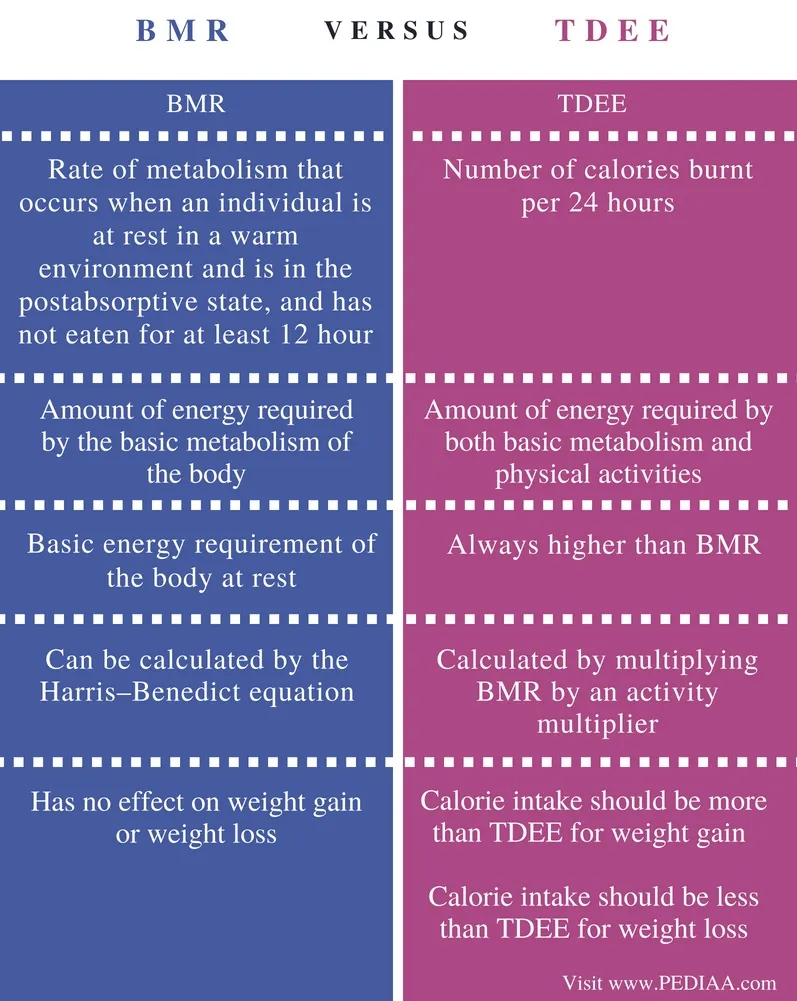
Here is a simple comparison in text:
-
- BMR:
- Calories your body needs to stay alive at rest
- Does not count walking, work, or exercise
- Good as a starting point or “minimum” number
- TDEE:
- Calories your body burns in a normal full day
- Includes BMR + all movement
- Best number to use for weight loss, gain, or maintenance plans
- BMR:
Think of BMR as the “engine idling” and TDEE as the “engine while driving.”
How Activity Level Changes TDEE
Your activity level changes your TDEE a lot.
The more you move, the more calories you burn.
Here are simple levels:
-
- Sedentary (very low activity):
- Mostly sitting, little walking
- TDEE is only a bit higher than BMR
- Lightly active:
- Some walking, light chores, maybe short walks
- TDEE is clearly higher than BMR
- Moderately active:
- Regular walking, standing, plus a few workouts per week
- TDEE is much higher than BMR
- Very active:
- Hard physical job or daily tough workouts
- TDEE can be much, much higher than BMR
- Sedentary (very low activity):
So two people with the same BMR can have very different TDEE if one moves a lot and the other sits most of the day.
Real-Life Example: Same BMR, Different Day
Imagine two people with the same BMR: 1,500 calories.
Person A: Office Day, Little Movement
-
- Works at a desk all day
- Short walk from car to office
- Light chores at home
Their TDEE might be around 1,800–1,900 calories.
BMR is still 1,500, but activity adds only a little.
Person B: Active Day
-
- Walks to work or takes long walks
- Stands a lot
- Does a 30-minute workout
Their TDEE might be around 2,200–2,400 calories or more.
Same BMR, but much more movement, so higher TDEE.
Which Number Should You Use for Weight Goals?
For most goals, TDEE is the main number to use.
-
- For weight loss:
- Start with your TDEE
- Eat a bit less than that number (a small calorie deficit)
- For weight gain or muscle gain:
- Start with your TDEE
- Eat a bit more than that number (a small calorie surplus)
- For weight loss:
BMR is still useful because it is the base.
But TDEE is what matches real life, with your movement added.
You can:
-
- Estimate your BMR with a BMR calculator.
- Multiply it by an activity factor (sedentary, light, moderate, active) to estimate your TDEE.
- Adjust your eating slightly up or down from TDEE for your goal.
Simple Step-by-Step Example
Step 1: Find BMR
You use an online calculator and see:
-
- BMR = 1,400 calories
Step 2: Add Activity for TDEE
You are lightly active (some walking).
Your TDEE might be around:
-
- 1,400 × about 1.4–1.5 ≈ 1,950–2,100 calories
Step 3: Use for Goals
-
- To lose weight slowly:
- You might aim for about 1,600–1,800 calories a day
- To maintain weight:
- You stay close to 1,900–2,100 calories
- To gain weight or build muscle:
- You might aim for 2,100–2,300 calories
- To lose weight slowly:
These are simple examples.
Your own best range depends on your body, health, and how you feel.
How BMR and TDEE Work Together
-
- BMR tells you the minimum your body needs at rest.
- TDEE tells you what your body needs with your real-life activity.
Use BMR to understand your body’s base needs.
Use TDEE to plan daily food for your goal:
-
- Deficit from TDEE → fat loss over time
- Match TDEE → weight maintenance
- Surplus over TDEE + training → possible muscle gain
Always make changes slowly and avoid extreme dieting.
FAQs About BMR vs TDEE
-
- Do I use BMR or TDEE to plan my calories?
Use TDEE for planning. BMR is just your resting burn; TDEE includes your activity and is better for real-life goals. - Why is my TDEE higher than my BMR?
TDEE includes all your movement: walking, cleaning, working, and exercise. BMR only counts resting needs. - Can TDEE change if my lifestyle changes?
Yes. If you start moving more or less, your TDEE will change because your daily burn goes up or down. - How often should I recalculate BMR and TDEE?
Every few months or when your weight or activity level changes a lot is usually enough. - Can I use BMR and TDEE if I am a beginner?
Yes. They are very helpful for beginners. They give you a clear starting point so you are not guessing your calorie needs.
- Do I use BMR or TDEE to plan my calories?