
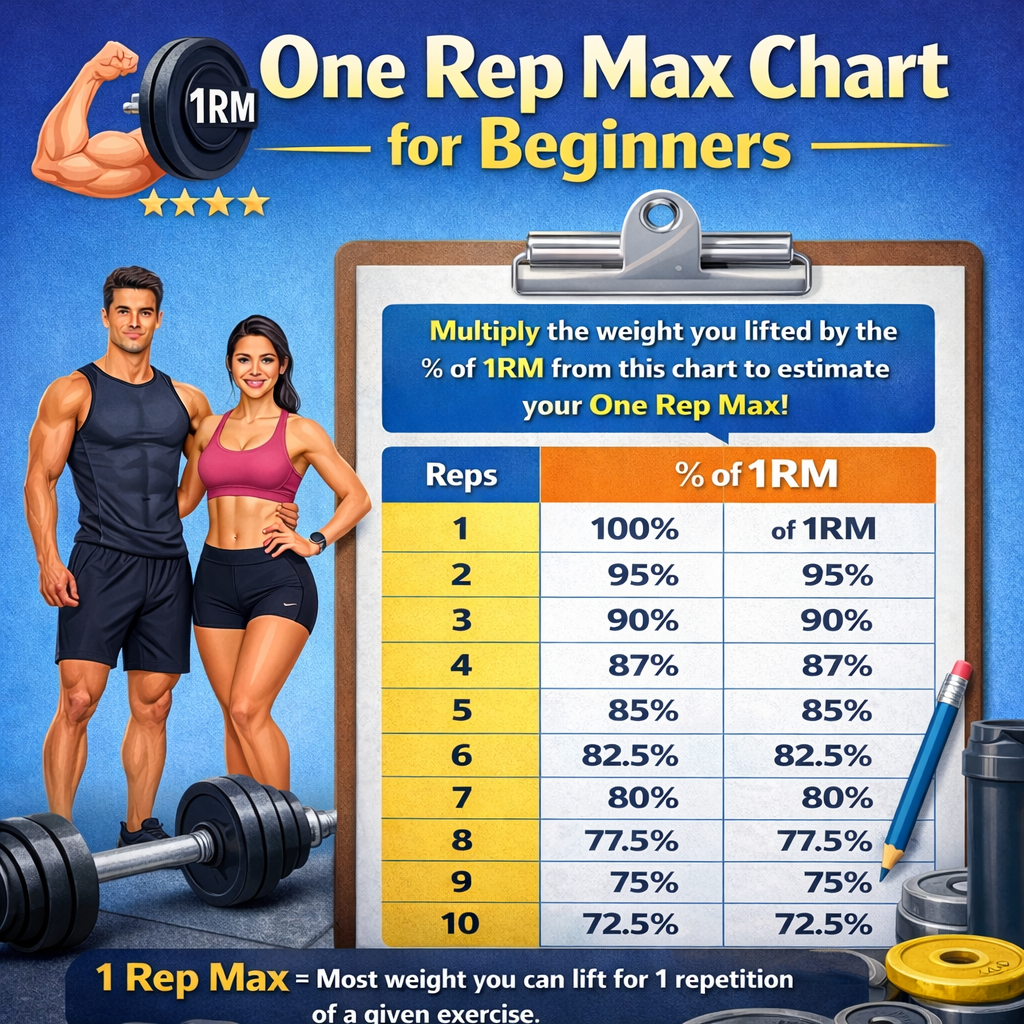
One rep max charts can look scary at first, but they are actually simple.
They are just tools to help you choose safe, smart weights for your workouts.
What Is a One Rep Max Chart?
A one rep max chart is a simple guide that shows:
-
- Your 1RM at the top (your max for 1 rep).
- Different percentages of that number.
- How many reps you can usually do at each percentage (rough idea).
You do not need to be perfect with the numbers.
You use the chart as a rough map, not a strict rule.
How to Read a 1RM Chart (Easy Explanation)
Most one rep max charts follow the same idea.
They might look like this in simple text:
-
- 100% of 1RM → about 1 rep
- 90% of 1RM → about 2–3 reps
- 80% of 1RM → about 6–8 reps
- 70% of 1RM → about 10–12 reps
- 60% of 1RM → about 12–15 reps
This means:
-
- The heavier the weight (closer to 100%), the fewer reps you can do.
- The lighter the weight (closer to 60–70%), the more reps you can do.
Everyone is slightly different, so your exact reps may not match the chart.
That’s okay. It’s just a guide.
Step 1: Get an Estimated One Rep Max
Before a one rep max chart can help you, you need a starting number.
The safest way:
-
- Use a weight you can lift 6–10 times with good form.
- Put that weight and rep number into an online 1RM calculator.
- Get an estimated 1RM (no need to test a true max).
You can use a simple tool like this: One Rep Max Calculator.
This gives you a number to use with the chart.
Step 2: Use the Chart to Pick Training Weights
Let’s say your estimated squat 1RM is 80 kg.
Now look at the simple chart ranges:
-
- 60% of 80 kg → about 48 kg
- 70% of 80 kg → about 56 kg
- 80% of 80 kg → about 64 kg
You can use these for different goals:
-
- Around 60–70% (48–56 kg):
- Good for beginners.
- 8–12 reps, focus on form and control.
- Around 70–80% (56–64 kg):
- More strength focused.
- 5–8 reps, heavier but still safe if your form is good.
- Around 60–70% (48–56 kg):
You don’t need to hit the exact number.
Being “close” is good enough.
Simple Example: Bench Press for a Beginner
Estimated 1RM bench press: 50 kg.
Use the chart idea:
-
- 60% → about 30 kg
- 70% → about 35 kg
- 80% → about 40 kg
A beginner plan might be:
-
- Warm-up with very light weight.
- Then 3 sets of 8–10 reps at around 30–35 kg (60–70% of 1RM).
This should feel:
-
- Challenging.
- But still controlled, with good technique.
How Beginners Should Use 1RM Charts Safely
For beginners, the chart is for guidance, not for chasing big numbers.
Here’s how to use it safely:
-
- Stay mostly in the 60–75% range of your 1RM.
- Focus on 6–12 reps per set.
- Choose weights where you could do one or two more reps if you had to.
- Avoid training at 90–100% of 1RM until you have good form and experience.
The goal is slow, steady progress, not “maxing out”.
Gradual Progression Using the Chart
You can also use a one rep max chart to progress step by step.
Example with a squat 1RM of 80 kg:
Week 1–2:
-
- 3 sets of 10 reps at about 50 kg (~65%).
Week 3–4:
-
- 3 sets of 8 reps at about 55 kg (~70%).
Week 5–6:
-
- 3 sets of 6–8 reps at about 60 kg (~75%).
When these feel easier:
-
- You can re-check your estimated 1RM using the calculator.
- If your new 1RM is higher, your training weights will also increase a little.
Important Safety Tips
-
- Treat the chart as a guide, not a rulebook.
- If a weight feels too heavy and your form breaks, lower the weight.
- Always warm up before using heavier sets.
- Never copy someone else’s numbers just because they are on the same chart.
- If you feel pain (not normal muscle effort), stop and rest.
Safety and good form matter more than any chart or number.
FAQs About One Rep Max Charts for Beginners
-
- Do I need a one rep max chart to get stronger?
No, but it can help. A chart gives you rough weight ranges so you don’t guess every time you train. - What if my reps don’t match the chart exactly?
That’s normal. Charts are general. Everyone is a bit different. Use them as a guide and listen to your body. - Is it safe for beginners to use heavy percentages from the chart?
Beginners should mostly stay in the 60–75% range of their 1RM and focus on form, not heavy singles. - How often should I change my training weights?
When a weight feels clearly easier and you can do more reps with good form, you can add a small amount (like 2.5 kg) or re-check your estimated 1RM. - How do I get the 1RM number I use with the chart?
Lift a weight you can do for 6–10 reps with clean form, then enter it into a tool like this One Rep Max Calculator. Use that estimate with the chart for safe, structured training.
- Do I need a one rep max chart to get stronger?