
BMI means Body Mass Index. It is a number made from your height and weight. If you are asking “What Is BMI?”, you are not alone. Many people use BMI as a quick check to understand their weight range.
BMI is not a full health test. It does not measure body fat. It also cannot tell why your weight is high or low. Still, in most businesses and clinics, BMI is a common first step.
What Is BMI (in simple words)?
BMI is a simple score that compares how heavy you are to how tall you are. It helps group adults into broad weight ranges. These ranges are often called underweight, healthy weight, overweight, and obesity.
Think of BMI like a “quick filter.” It can help you decide if you should look deeper at your health habits. But it cannot give a diagnosis.
Why do people use BMI?
In real projects, I see people like BMI because it is easy and fast. You only need two things: height and weight.
People use BMI to:
-
- Get a quick idea of their weight range
- Track changes over time (month to month)
- Use a common number that doctors and apps understand
- Compare results in health studies
BMI formula (clear and simple)
You can calculate BMI in two main ways. It depends on the units you use.
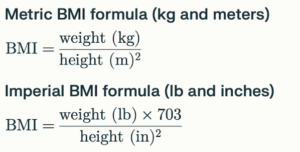
If you do not want to do the math, you can use the BMI calculator here:
Adult BMI categories (common ranges)
For most adults, BMI is grouped like this:
-
- Underweight: less than 18.5
- Healthy weight: 18.5 to 24.9
- Overweight: 25.0 to 29.9
- Obesity: 30.0 or higher
These ranges are widely used around the world. But health risk can still depend on many things. Age, muscle, and where you carry fat can matter.
3 real-life BMI examples (easy math)
Simple examples make BMI easier to understand. Here are three common cases.
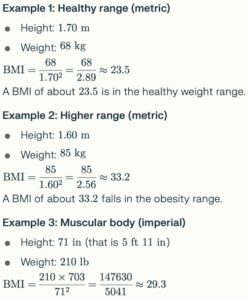
A BMI of about is in the overweight range. But if this person has a lot of muscle, BMI may look “too high” for them.
What BMI can tell you (and what it cannot)
BMI can help, but it has limits. It is best used as a starting point.
What BMI can help with
BMI can:
-
- Give a quick weight check for adults
- Help you notice trends over time
- Support goals like weight gain or weight loss planning
- What BMI cannot do
BMI cannot:
-
- Measure body fat directly
- Show where fat is stored (like belly fat)
- Explain your diet, sleep, or fitness level
From practical use, I find BMI works best when you also look at other signs, like waist size, energy levels, and activity.
When BMI may be less accurate
BMI can be less helpful in some cases. Here are common examples:
-
- Very muscular people (BMI can read high)
- Older adults (muscle loss can change the number)
- Pregnant people (BMI is not used the same way)
- Children and teens (they need a different BMI method)
If you are unsure, a health professional can help you understand your results in a safe way.
BMI for children and teens (quick note)
For ages 2 to 19, BMI is not read the same way as adults. Doctors use BMI-for-age percentiles.BMI calculation These percentiles compare a child to others of the same age and sex.
So, do not use adult BMI ranges for kids. If you need help, ask a pediatric clinician.
How to use BMI in a smart way
In most businesses, people want one clear number. BMI gives that. But you should use it wisely.
Try these simple steps:
-
- Use BMI as a first check, not the final answer
- Track your BMI over time, not just once
- If your BMI is outside the healthy range, look at habits too
- Ask a clinician if you have health worries or symptoms
Use our BMI calculator (fast and easy)
If you want a quick result, use our tool at BMI Calculator. You enter your height and weight, and it shows your BMI in seconds. It also shows the BMI category, so you do not need to guess.
Conclusion: What Is BMI and why it matters
What Is BMI? It is a simple number based on height and weight. It helps many adults understand their weight range fast. BMI is not a full health report, and it does not measure body fat. But it can be a useful first step. If you want to check your number now, try the tool at /bmi-calculator/.
FAQ:
1) Is BMI a medical diagnosis?
No. BMI is a screening tool. It can suggest a weight range, but it cannot diagnose a health problem.
2) What is a healthy BMI?
For most adults, a healthy BMI is from 18.5 to 24.9. But your best range can depend on your body and health history.
3) Can BMI be wrong for athletes?
Yes. Muscle can raise weight, and BMI may look high even when body fat is not high.
4) Should kids use BMI the same way as adults?
No. Kids and teens use BMI-for-age percentiles. Adult BMI ranges do not apply to them.
5) What should I do if my BMI is high or low?
First, do not panic. Use BMI as a starting point. Consider your habits, waist size, and how you feel. If you need personal guidance, talk to a health professional.